September 11 attacks (2001)
Terrorist attacks in the United States killed nearly 3,000 people and profoundly changed security policy, foreign affairs and daily life.
2000—2009 · A CONNECTED DECADE
Broadband, social media, digital music and smartphones changed how people communicated and consumed media, while terrorism, war, climate concerns and the financial crisis reshaped the wider world.

OVERVIEW
The 2000s opened with the Y2K scare fading away, but the September 11 attacks in 2001 quickly reshaped global politics, security and foreign policy.
Wars in Afghanistan and Iraq became defining political events, while terrorism and expanded security measures affected travel, government policy and public debate.
At the same time, technology moved rapidly into daily life. Broadband replaced dial-up for many households, portable digital music became mainstream, camera phones improved and social networking turned online identity into an everyday habit.
The launch of the iPhone in 2007 pointed toward a new smartphone era in which internet access, media, messaging and software would increasingly live on a touchscreen device.
Climate change gained wider political and public attention, while disasters such as the Indian Ocean tsunami and Hurricane Katrina exposed the vulnerability of cities and coastal communities.
Popular culture became more participatory. Reality television flourished, blogs multiplied, viral videos spread through the web and online fandoms connected people across national borders.
The decade ended with the global financial crisis and Great Recession, interrupting years of credit expansion, housing growth and consumer confidence.
02 / EVENTS
Terrorist attacks in the United States killed nearly 3,000 people and profoundly changed security policy, foreign affairs and daily life.
The United States and allies launched military operations after the September 11 attacks, beginning a conflict that continued far beyond the decade.
A U.S.-led coalition invaded Iraq and overthrew Saddam Hussein, followed by years of occupation, insurgency and political instability.
A massive undersea earthquake triggered a tsunami that devastated communities across South and Southeast Asia.
The storm and catastrophic flooding caused widespread destruction along the U.S. Gulf Coast, especially in New Orleans.
Housing-market collapse and failures across the financial system triggered a severe international recession.
Obama became the first African American elected to the U.S. presidency.
A new strain of influenza spread internationally and led to a coordinated global public-health response.
Major enlargements in 2004 and 2007 brought twelve additional countries into the European Union.
Researchers announced completion of the international effort to map and sequence the human genome.
Spirit and Opportunity were launched in 2003 and landed on Mars in 2004 to study the planet’s geology.
Coordinated attacks on London public transport killed 52 victims and injured hundreds.
The death of the long-serving pope drew enormous crowds to Rome and global attention to the papal succession.
The former Iraqi president was executed after conviction by the Iraqi High Tribunal.
The campus shooting in Blacksburg, Virginia, killed 32 victims and intensified debate over gun violence and campus safety.
China hosted the Summer Olympic Games in a globally watched display of sport, infrastructure and national ambition.
Coordinated attacks across Mumbai targeted hotels, a railway station and other locations over several days.
Pakistan’s former prime minister was killed during an election campaign rally in Rawalpindi.
Kosovo declared independence from Serbia, a step recognized by many countries but contested by others.
Russia and Georgia fought a brief war centered on South Ossetia and Abkhazia.
03 / TECHNOLOGY
Many technologies associated with the 2000s existed earlier, but this was the decade when digital music, broadband, social networking, GPS, video sharing and touchscreen mobile computing reached huge consumer audiences.
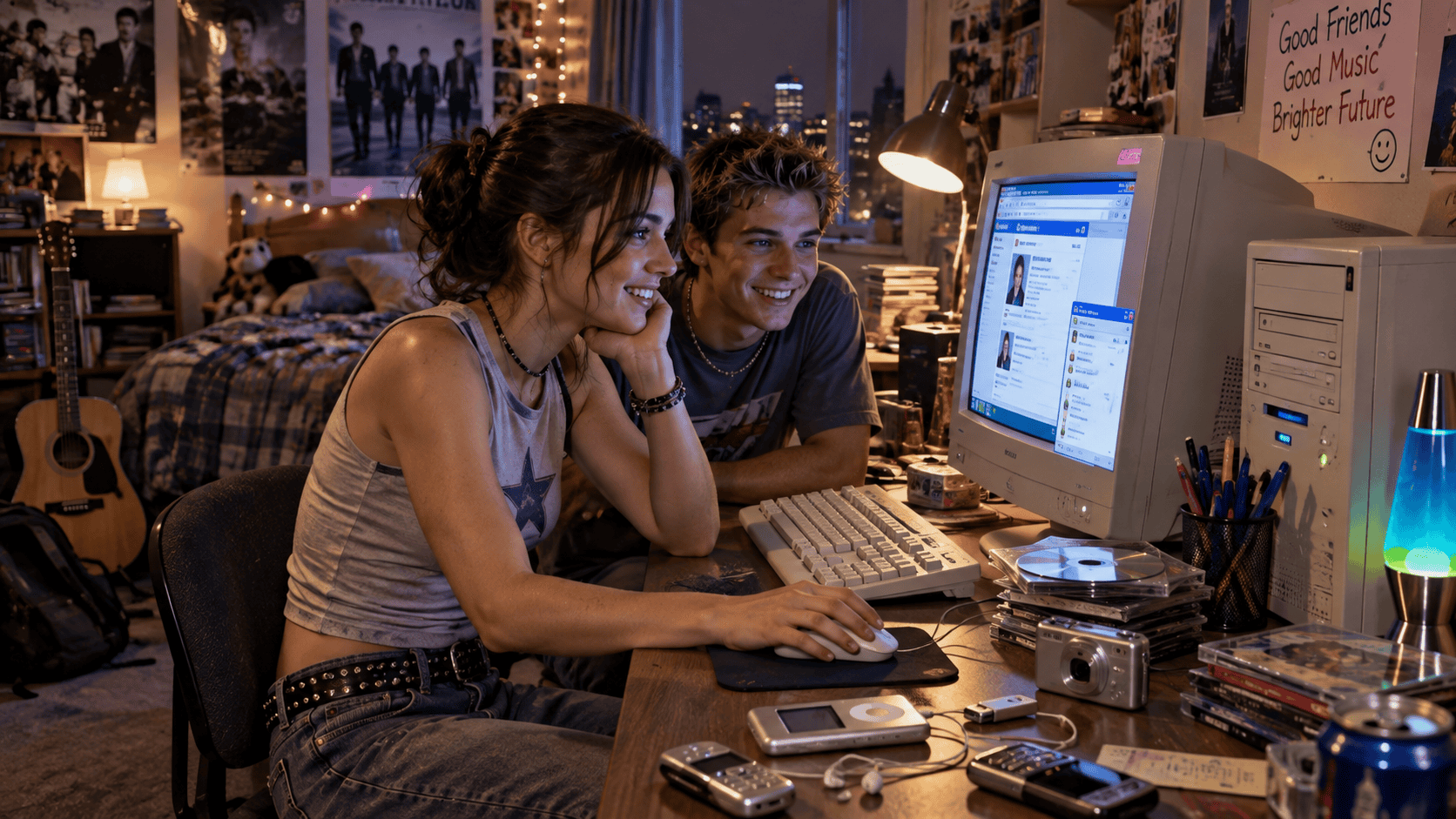
Apple’s portable music player made large digital music libraries easy to carry and helped reshape listening habits.
Small solid-state storage devices became a convenient replacement for floppy disks and other portable media.
Mobile phones with built-in cameras spread rapidly and changed casual photography, messaging and news gathering.
The collaborative online encyclopedia made large-scale user-edited reference publishing a mainstream internet phenomenon.
The robotic vacuum brought autonomous household cleaning into the consumer market.
Internet calling and video chat made long-distance communication cheaper and more accessible.
The social network expanded from a college service into a major platform for online identity and communication.
Easy video uploading and sharing transformed online entertainment, news and creator culture.
Short public posts and real-time updates created a new style of online conversation.
The touchscreen smartphone combined phone, music, web browsing and apps in a highly influential mobile format.
Amazon’s e-reader helped push digital books into the mainstream.
Google’s mobile operating system created a widely adopted platform for touchscreen smartphones.
The online lodging marketplace helped expand peer-to-peer travel and short-term rentals.
The decentralized digital currency introduced a blockchain-based system for transferring value without a central issuer.
The high-capacity optical format became a major carrier for high-definition home video.
Touchscreens capable of recognizing multiple fingers made gestures such as pinch-to-zoom familiar to millions of users.
Dashboard and handheld navigation devices made turn-by-turn satellite directions common in everyday driving.
Models such as the Toyota Prius helped move gasoline-electric powertrains into mainstream public awareness.
Interactive websites increasingly centered on profiles, comments, sharing, tagging and user-created content.
Faster always-on connections replaced dial-up for many households and made streaming, social media and large downloads practical.
04 / CULTURE
Shows built around competitions, celebrities and unscripted situations became a dominant television format.
Emotional punk-influenced music, dark fashion and highly personal lyrics developed a large youth following.
Urban scenes embraced independent music, vintage clothing, bicycles, coffee culture and deliberately alternative tastes.
Abbreviations, emoticons and compressed phrases became part of everyday mobile communication.
Personal journals and independent commentary became important forms of online publishing.
Compact digital cameras, webcams and social profiles encouraged casual self-portraits before smartphones made them universal.
The books and films became a global cultural force across publishing, cinema, merchandise and fandom.
Comic-book adaptations grew into major mainstream film franchises.
Media discussions focused on men’s fashion, grooming and consumer habits in new ways.
The number puzzle became an international newspaper and book phenomenon.
Groups organized online to gather briefly in public for coordinated performances or unexpected events.
Short clips spread rapidly through email, forums and video-sharing sites.
Televised tournaments and online poker made Texas Hold’em a mainstream entertainment trend.
Styles from the 1980s and 1990s returned through denim, sneakers, vintage T-shirts and accessories.
Japanese animation and comics reached much larger international audiences.
Bloggers, video creators and social-media figures began shaping tastes and buying decisions.
Skateboarding, BMX, snowboarding and other action sports gained greater media visibility.
Large chains and independent cafés became everyday spaces for meeting, studying and working.
Television, film, music and public debate featured more openly LGBTQ+ people and stories.
Restaurant discovery, celebrity chefs, cooking television and online reviews turned food into a major lifestyle interest.
AMERICA
The city faced the trauma and rebuilding that followed the September 11 attacks while finance, media and culture continued evolving.
Hurricane Katrina and the failure of flood protections devastated the city in 2005 and shaped a long recovery.
Mega-resorts, nightlife and large-scale entertainment continued transforming the Strip.
Technology companies, coffee culture and a strong creative economy helped define the city’s 2000s identity.
Real-estate growth, nightlife, Latin American culture and art transformed the city’s global profile.
After the dot-com crash, new social-media and Web 2.0 companies helped launch another technology boom.
The city reflected the decade’s wars, security measures, political polarization and expanding federal activity.
Film, television, music and new digital media adapted to internet distribution and changing audiences.
Downtown redevelopment, architecture and public-space projects continued reshaping the city.
Biotechnology, universities and completion of major phases of the Big Dig influenced the local economy and cityscape.
Rapid metropolitan growth, logistics, media and a major airport strengthened the city’s role as a southeastern hub.
A housing boom and rapid Sun Belt migration expanded the metropolitan area before the financial crisis.
Automobile-industry restructuring and the 2008–2009 downturn intensified long-running economic challenges.
Energy, medicine and immigration supported growth and increasing cultural diversity.
Country music, healthcare and tourism broadened the city’s economic and cultural reach.
Cycling, sustainability, independent businesses and alternative culture strengthened the city’s national image.
Technology, live music and the 'Keep Austin Weird' identity fueled rapid growth.
Outdoor recreation, population growth and redevelopment helped expand the city’s appeal.
Theme-park expansions and international tourism kept the metropolitan area growing.
Downtown redevelopment, arts institutions and a diverse regional economy supported urban renewal.
06 / FASHION
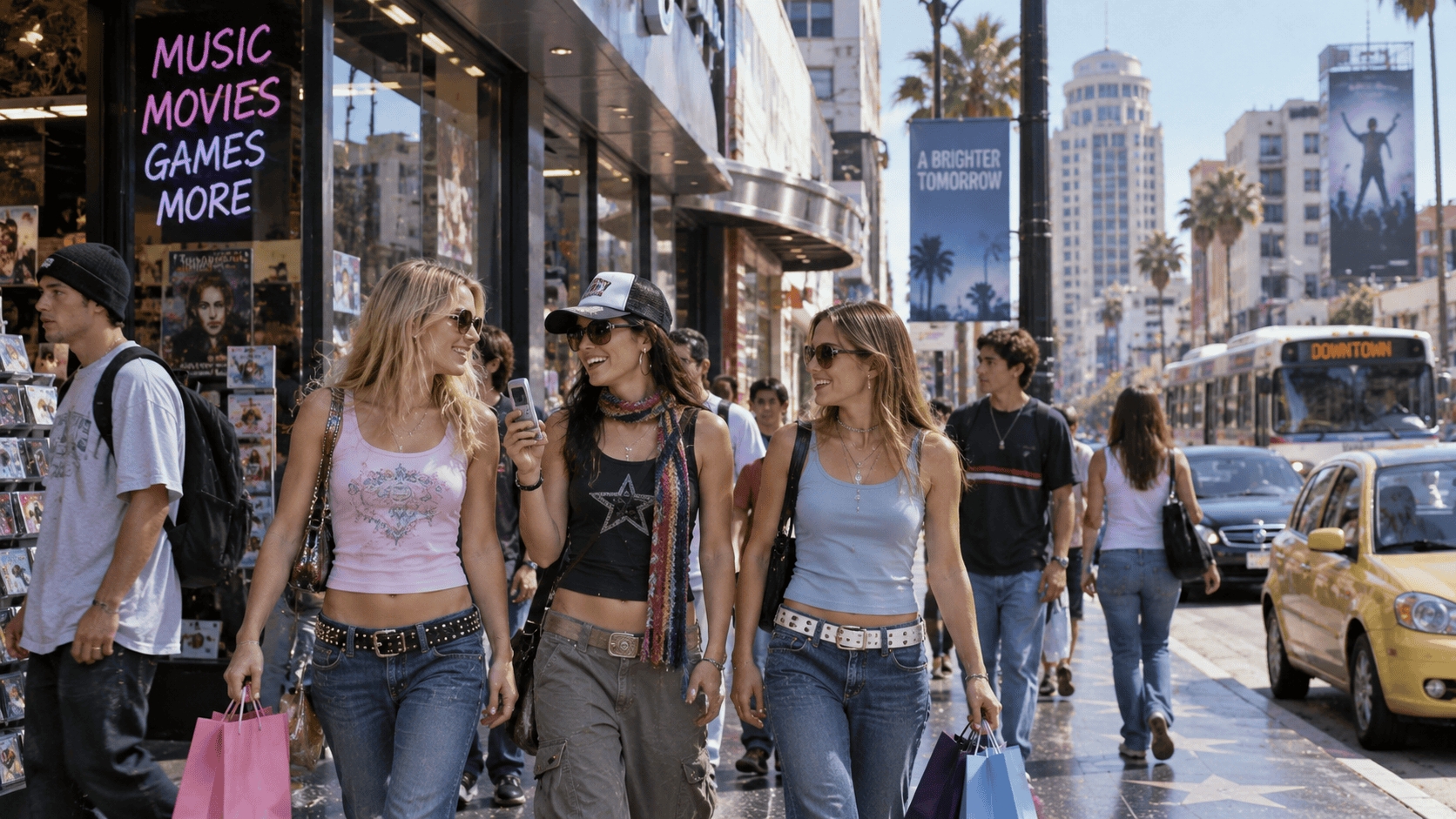
Early-2000s fashion mixed celebrity glamour, mall culture, surf references, punk and emo details, while the second half of the decade moved toward skinny jeans, indie looks and more streamlined silhouettes.
Hip-hugging denim became one of the decade’s most recognizable early-2000s silhouettes.
Soft, bulky boots became a widely copied casual winter style.
Mesh-backed caps crossed from workwear and advertising into celebrity fashion.
Bright matching loungewear became a signature look of celebrity street style.
Slim denim gained momentum in the second half of the decade through indie and rock-influenced fashion.
Midriff-baring tops remained a major part of pop and casual fashion.
Large pockets and utilitarian styling carried over from late-1990s streetwear.
Thick-soled sandals became a familiar warm-weather look.
Layered polo shirts with raised collars became associated with preppy casual style.
Slightly flared denim paired easily with sneakers, heels and boots.
Highly visible branded hats became part of celebrity-driven casual fashion.
Personalized jewelry returned through collectible charms and decorative pendants.
Punk and emo styling pushed metal-studded accessories into the mainstream.
Calf-length trousers remained popular for casual women’s outfits.
Bleached hair ends continued as a recognizable early-decade men’s hairstyle.
High-contrast hair color created a deliberately bold salon look.
Printed squares were worn as headbands, neckwear and casual styling pieces.
Multiple fitted tops in contrasting colors were often worn together.
Beach-inspired shell jewelry became part of surf and teen style.
Large tinted frames became closely associated with celebrity and nightlife fashion.
07 / MOVIES
Peter Jackson’s fantasy trilogy combined large-scale location work, visual effects and motion capture.
James Cameron’s science-fiction spectacle pushed 3D exhibition and digital visual effects into the mainstream.
The superhero crime thriller brought a darker tone and extraordinary box-office success to comic-book cinema.
Ridley Scott’s Roman epic helped revive large-scale historical adventure films.
Hayao Miyazaki’s animated fantasy became an international critical and commercial success.
The spy thriller launched a franchise known for its stripped-down action and modern espionage tone.
Pixar’s underwater adventure paired computer animation with a family story about loss and trust.
The romantic drama used memory erasure to explore love, regret and identity.
The romantic drama brought a same-sex love story to a large mainstream cinema audience.
Martin Scorsese’s Boston crime film won the Academy Award for Best Picture.
Paul Thomas Anderson’s oil-boom drama explored ambition, faith and power.
The Mumbai-set drama became a global hit and won the Academy Award for Best Picture.
Christopher Nolan’s nonlinear thriller used fragmented chronology to mirror memory loss.
Ang Lee’s wuxia epic brought martial-arts fantasy to a large international audience.
Roman Polanski’s Holocaust drama followed a Polish Jewish musician surviving occupied Warsaw.
Sofia Coppola’s Tokyo-set film explored loneliness, connection and cultural displacement.
Clint Eastwood’s boxing drama became a major awards success.
The dystopian thriller combined political rebellion, masked symbolism and comic-book adaptation.
Guillermo del Toro blended dark fantasy with the violence of Francoist Spain.
The Coen brothers’ neo-western crime film won the Academy Award for Best Picture.
08 / MUSIC
Digital libraries and legal downloads changed how listeners bought, organized and carried music.
The album and title track captured the scale of early-2000s teen pop.
The bestselling rap album intensified debates around celebrity, provocation and hip-hop culture.
The genre-blending hit became one of the decade’s most recognizable crossover singles.
The album fused modern songwriting with soul and girl-group influences.
The virtual band mixed animation, hip-hop, rock and electronic music into a distinctive multimedia identity.
The album became central to the early-2000s garage-rock revival.
The hit established Beyoncé’s solo career with a powerful blend of R&B, pop and hip-hop.
The debut album broadened mainstream hip-hop through soul sampling, humor and personal themes.
The crossover single blended soul, electronic textures and alternative pop.
The band’s rise showed how online sharing could build an audience before a major album release.
The 2007 hit became a defining global pop and R&B single.
Its instantly recognizable guitar riff became one of the decade’s enduring rock hooks.
French house reached mainstream audiences through bright electronic dance music.
The piano-led single introduced a major new R&B voice.
The single pushed polished pop toward harder electronic rhythms.
The punk-rock concept album became a major commercial and political-cultural event.
The track combined unusual rhythms, futuristic sound design and commanding rap performance.
The piano-driven song became a staple of 2000s alternative rock radio.
The late-decade hit helped usher glossy electropop into the next era of mainstream pop.
09 / CARS
The hybrid hatchback became a global symbol of fuel efficiency and lower-emission driving.
BMW’s revival of the British icon blended retro design with modern compact-car engineering.
The rounded coupe remained one of the decade’s most recognizable design-led sports cars.
Retro styling and practical packaging made the unusual compact a major early-decade success.
The oversized SUV became a symbol of the era’s taste for large, highly visible vehicles.
The electric sports car demonstrated that battery-powered vehicles could deliver serious performance.
Extreme power and speed made the hypercar a symbol of engineering excess.
The ultra-short city car emphasized efficiency and easy urban parking.
Advanced all-wheel drive and turbocharged performance made the Japanese coupe a global benchmark.
Luxury, performance and SUV capability converged in a highly visible premium model.
The rotary-powered four-door sports coupe offered an unconventional approach to performance.
The fifth-generation model revived styling cues from the classic 1960s Mustang.
Porsche’s first SUV helped redefine expectations for performance luxury vehicles.
The boxy compact SUV emphasized flexible interior space and an active-lifestyle image.
Sharp styling and rear-wheel drive helped reposition Cadillac for a younger luxury audience.
The retro-inspired compact remained a familiar symbol of turn-of-the-century nostalgia.
The limited-run supercar incorporated Formula One-inspired technology and dramatic bodywork.
The revived muscle car returned late in the decade with styling inspired by its 1970 predecessor.
The luxury sedan combined quietness, electronics and high levels of comfort.
Turbocharged power and rally heritage made the compact sedan a favorite among enthusiasts.
10 / LEGACY
The 2000s changed the architecture of everyday life. Search, social networking, online video, digital music and broadband made the internet central to communication and entertainment.
The decade also established the smartphone as a new kind of personal computer and helped create the platform economy that would dominate the 2010s.
Its political and economic legacy was equally powerful: the September 11 attacks, wars in Afghanistan and Iraq, expanding security systems and the Great Recession shaped public life well beyond 2009.
11 / FAQ
The decade is remembered for the September 11 attacks, wars in Afghanistan and Iraq, the Great Recession, broadband internet, social media, smartphones, reality television and major changes in digital entertainment.
Broadband, search engines, blogs, social networks, video sharing and online shopping made the internet an everyday social, commercial and entertainment space.
Portable digital music, camera phones, USB storage, social media, video sharing, GPS navigation, smartphones and faster broadband connections all reshaped daily routines.
Hip-hop, R&B, teen pop, indie rock, emo, garage rock, electronic dance music and digital-download culture all played major roles.
Low-rise and bootcut jeans, velour tracksuits, trucker hats, cargo pants, layered tops, oversized sunglasses and later skinny jeans were all strongly associated with the decade.
The decade moved social life, media, shopping, music and communication onto digital platforms and established many of the habits that define smartphone-era culture.